StrategyJuly 2026
Why Businesses That Invest in Strategy Grow Faster Than Those That Invest Only in Marketing
Advertising, a redesign, a new agency: each can help, but rarely lasts without strategy. Here is why strategy-led businesses grow faster.
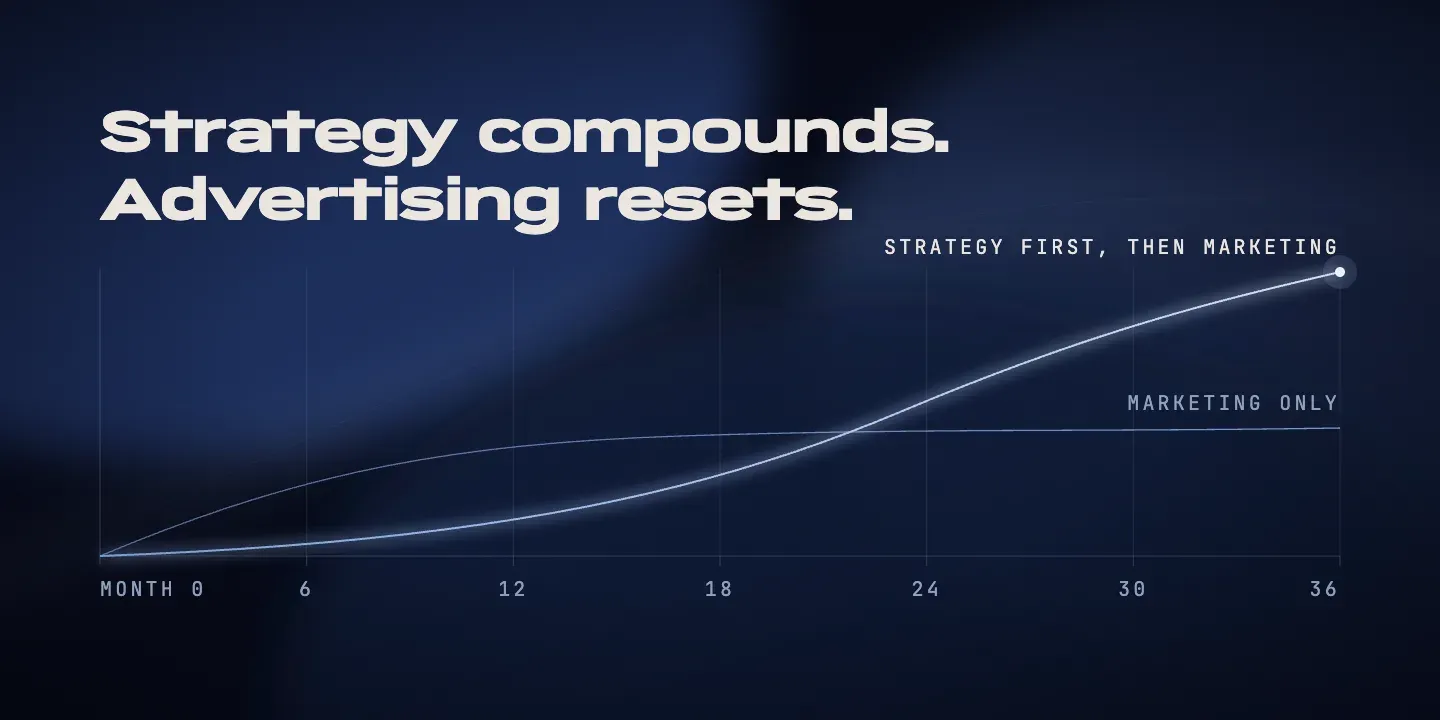
Every business wants to grow.
Some invest in advertising. Others redesign their website, hire a marketing agency or become more active on social media. These initiatives can certainly help, but they often fail to produce lasting results because they’re solving the wrong problem.
Growth doesn’t begin with marketing.
It begins with strategy.
The fastest-growing companies don’t ask, “How do we get more customers?” They ask, “How do we build a business that consistently attracts, converts and retains customers?”
That difference in thinking changes everything.
Marketing is only one piece of the puzzle. Without a clear strategy behind it, businesses often find themselves reacting to problems instead of building sustainable growth.
Strategy Gives Every Decision a Purpose
Businesses make hundreds of decisions every month.
Should we launch a new service?
Should we hire another salesperson?
Should we invest in Google Ads?
Should we lower our prices?
Should we target a new market?
Without a strategy, these decisions are usually based on instinct or short term pressure. One month the focus is social media. The next it’s SEO. Then paid advertising. Then a new website. The business keeps moving, but rarely in the same direction.
A clear strategy creates consistency. Every investment supports the same objective, and every department understands where the business is heading.
Growth becomes intentional instead of reactive.
More Marketing Won’t Fix a Weak Business Model
One of the biggest misconceptions in business is that poor sales automatically require more marketing.
Sometimes they do.
Often they don’t.
If customers don’t understand your offer, marketing won’t fix it.
If your pricing is confusing, marketing won’t fix it.
If your sales process is slow, marketing won’t fix it.
If your customer experience is inconsistent, marketing won’t fix it.
Marketing amplifies your business. It doesn’t repair it.
This is why companies with average marketing sometimes outperform competitors with much larger advertising budgets. Their foundations are simply stronger.
Strategy Starts With Asking Better Questions
Before spending money on marketing, successful businesses ask questions that many companies never consider.
Who is our ideal customer?
What problem do we solve better than anyone else?
Why should someone choose us instead of our competitors?
Which services generate the highest profit?
Where are we losing customers?
What does success actually look like twelve months from now?
These questions aren’t exciting.
They don’t produce immediate results.
But they create the clarity every successful business depends on.
Without clear answers, marketing becomes little more than educated guessing.
Business Development Is More Than Finding New Clients
Many people associate business development with sales.
In reality, it goes much further.
Business development looks at how a company grows as a whole.
It identifies new markets, develops partnerships, improves customer retention, refines pricing strategies, creates new revenue opportunities and strengthens competitive positioning.
Sometimes growth comes from attracting more customers.
Sometimes it comes from increasing the value of existing customers.
Sometimes it comes from improving operational efficiency.
The businesses growing fastest usually work on all three.
Every Department Should Support the Same Goal
Businesses often operate in silos.
Marketing has its objectives.
Sales has different priorities.
Operations focuses on delivery.
Management concentrates on financial performance.
Each department works hard, but not always together.
Strategy aligns every part of the business around common objectives.
Marketing attracts the right customers.
Sales converts them efficiently.
Operations delivers an exceptional experience.
Customer service builds loyalty.
Management measures performance and identifies new opportunities.
When every department moves in the same direction, growth becomes significantly easier to achieve.
The Best Businesses Measure More Than Revenue
Revenue is important.
But revenue alone doesn’t explain why a business is growing or slowing down.
Successful companies monitor the numbers that influence future growth.
Customer acquisition cost.
Lead conversion rate.
Customer lifetime value.
Retention rate.
Average response time.
Sales cycle length.
Referral rate.
These metrics help leaders identify problems before they affect revenue. Instead of reacting to declining performance, they improve the business continuously.
Growth becomes measurable instead of unpredictable.
Strategy Isn’t a One Time Exercise
Markets change.
Technology evolves.
Customer expectations shift.
Competitors introduce new products.
What worked two years ago may not work today.
This is why strategy should never be treated as a document that sits inside a drawer after a planning session.
Successful businesses review their strategy regularly. They analyse performance, evaluate market changes and adjust their priorities before problems become significant.
The companies that continue growing aren’t necessarily the ones with the best original plan.
They’re the ones that adapt the fastest.
Businesses That Scale Successfully Build Systems
Growth creates complexity.
More customers mean more enquiries.
More employees.
More projects.
More communication.
Without systems, every stage of growth becomes more difficult to manage.
This is why scalable businesses invest in processes long before they become necessary.
Clear sales pipelines.
Documented procedures.
CRM systems.
Automation.
Reporting dashboards.
Defined responsibilities.
Strong systems don’t slow businesses down.
They allow businesses to grow without losing quality.
Growth Requires Continuous Optimisation
Many businesses believe growth happens through one major decision.
A successful advertising campaign.
A new website.
A large client.
An investment.
In reality, sustainable growth usually comes from hundreds of small improvements made consistently over time.
Improving website conversion rates by five percent.
Reducing response times by two hours.
Increasing customer retention by three percent.
Automating repetitive tasks.
Improving proposal quality.
Strengthening internal communication.
Individually, these improvements may seem small.
Together, they fundamentally change how a business performs.
The companies growing year after year understand that optimisation never stops.
How DIGI MANTA Helps Businesses Build Sustainable Growth
At DIGI MANTA, we don’t believe growth begins with advertising.
It begins with understanding your business.
Before recommending marketing campaigns, websites or AI solutions, we analyse how your business operates, where opportunities are being lost and what changes will create the greatest long term impact.
Sometimes the answer is a stronger sales process.
Sometimes it’s better positioning.
Sometimes it’s automation.
Sometimes it’s a completely different growth strategy.
Every recommendation is based on one objective: building a business that grows consistently, not just temporarily.
That’s why our approach combines Business Development, Growth Strategy, Marketing, Sales, Branding and AI Automation into one connected system.
Because businesses don’t grow by doing more.
They grow by doing the right things, in the right order, and improving them continuously.