StrategyJuly 2026
Why Marketing Alone Won't Bring You Sales If Your Sales Strategy Is Broken
When enquiries slow down, more marketing is the obvious fix. But if your sales process is slow or inconsistent, no campaign can make up for it.
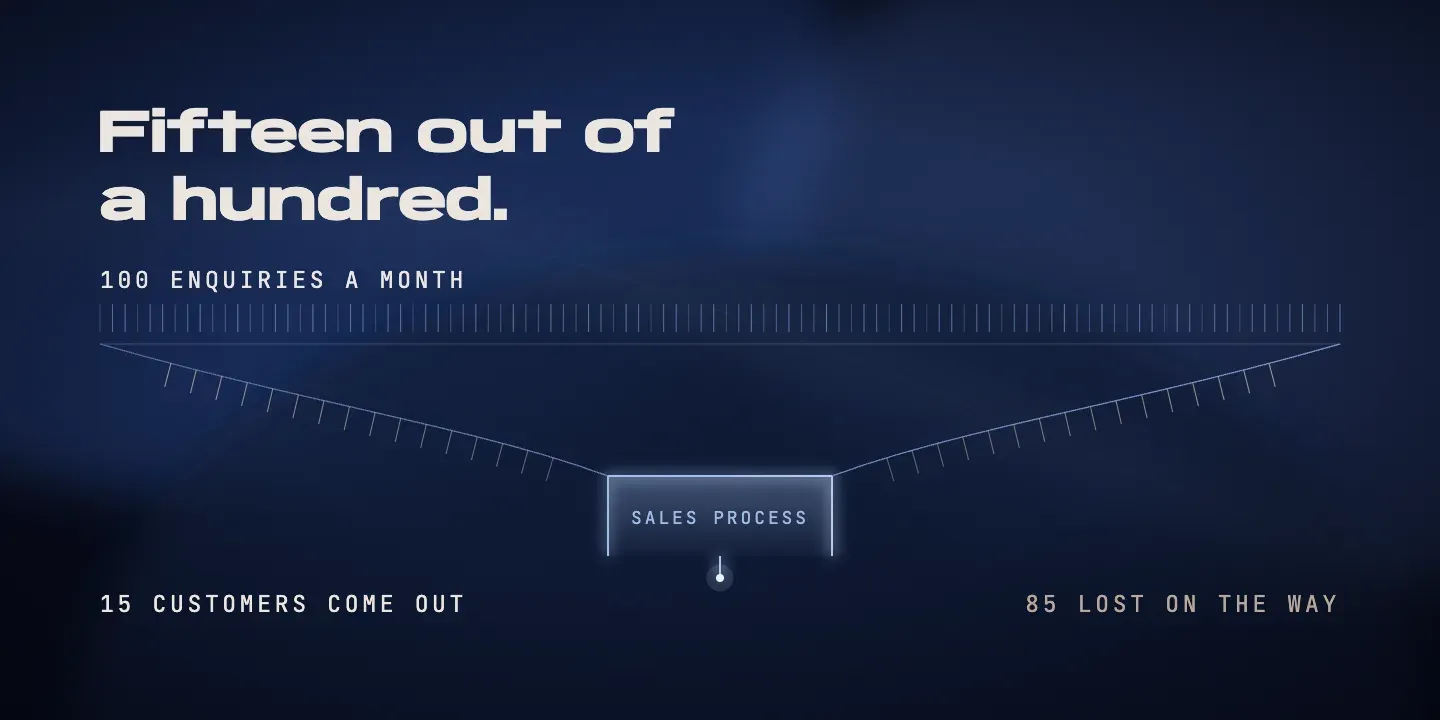
Many businesses believe that sales problems can be solved with more marketing. When enquiries slow down, the first reaction is often to increase the advertising budget, publish more content or redesign the website. Marketing becomes the obvious target because it is the most visible part of the business. Yet after investing more money, many companies find themselves asking the same question a few months later: Why aren’t we growing?
The answer is often uncomfortable because marketing was never the problem. Marketing can attract attention, generate interest and encourage potential customers to contact your business. What happens next depends entirely on your sales strategy. If your sales process is inconsistent, slow or poorly structured, no marketing campaign will compensate for it. Businesses don’t fail because people don’t know they exist. They fail because they cannot consistently convert interest into revenue.
Marketing Generates Opportunities. Sales Generate Revenue.
Marketing and sales should never be viewed as competitors inside a business. They perform two completely different functions. Marketing creates awareness, builds trust and encourages potential customers to take the first step. Sales turns that interest into paying customers.
Imagine investing €5,000 every month in advertising. Your campaigns perform well, your website traffic doubles and your contact form starts receiving enquiries every day. On paper, everything looks like a success. Now imagine those enquiries waiting two days for a response because everyone is busy. Some receive generic quotations with no personalisation. Others never receive a follow-up because there is no structured process for managing leads. Before long, most of those potential customers have already chosen another supplier.
Marketing didn’t fail. The business did.
This happens far more often than most business owners realise. Companies frequently measure the number of leads they receive but rarely measure what happens after those leads arrive. Without that visibility, marketing becomes the scapegoat while the real problem remains untouched.
More Leads Will Not Fix a Broken Sales Process
One of the most common mistakes businesses make is assuming that more leads automatically translate into more sales. It seems logical, but reality tells a different story. If your current sales process converts only a small percentage of enquiries into customers, increasing the number of enquiries simply increases the number of lost opportunities.
Consider a business that receives one hundred enquiries every month and converts only fifteen into customers. Their first instinct is often to invest more in advertising to generate another hundred enquiries. Yet if nothing changes internally, they will simply lose another eighty-five potential customers. Instead of doubling their marketing budget, they would often achieve a far greater return by improving how they respond to the leads they already receive.
This is why successful companies constantly monitor their conversion rates. They know exactly how many enquiries become meetings, how many meetings become proposals and how many proposals become paying customers. Every stage is measured because every stage represents an opportunity to improve.
A Sales Strategy Is More Than Closing Deals
Many people associate sales with conversations, negotiations and closing techniques. In reality, a sales strategy begins long before anyone picks up the phone.
It starts with understanding your ideal customer. It continues with developing an offer that solves a genuine problem. It includes pricing, positioning, response times, qualification processes, follow-up sequences and customer communication. Every one of these elements influences whether someone decides to buy from you or from your competitor.
Businesses that consistently grow rarely depend on talented salespeople alone. They build repeatable systems that produce consistent results regardless of who answers the enquiry. That consistency is what separates scalable businesses from those that rely entirely on individual effort.
The Hidden Cost of Slow Responses
Speed has become one of the biggest competitive advantages in modern business. Customers compare suppliers within minutes, not days. Artificial intelligence allows buyers to research products, read reviews and compare prices faster than ever before. If your business takes two days to respond to an enquiry, someone else has already started building a relationship with that customer.
Research has repeatedly shown that businesses responding quickly to enquiries achieve significantly higher conversion rates than those that delay. Yet many organisations still rely on manual processes, shared inboxes and memory to manage leads.
This is not simply an operational problem. It is a revenue problem.
Every delayed response reduces the likelihood of winning the customer. Every forgotten follow-up represents marketing money that has already been spent but will never generate a return.
Why Marketing and Sales Must Work Together
One of the biggest weaknesses in many organisations is the disconnect between marketing and sales. Marketing generates enquiries without understanding what happens afterwards. Sales teams receive leads without providing feedback on their quality. Management measures revenue without identifying where prospects are dropping out of the journey.
When these departments operate independently, opportunities are lost.
When they work together, the results improve dramatically. Sales conversations reveal the questions customers ask most frequently. Marketing can use those insights to create more relevant content, stronger campaigns and better-qualified leads. Marketing data highlights which channels produce the highest quality enquiries, allowing sales teams to prioritise their efforts. Together, they create a continuous improvement cycle where every campaign becomes more effective than the last.
Businesses often search for a single solution that will suddenly increase sales. The reality is far less dramatic. Sustainable growth usually comes from improving dozens of small processes that collectively produce better results.
Technology Alone Will Not Save Your Business
Artificial intelligence has transformed the way businesses operate. CRM systems can automate follow-ups, AI assistants can qualify leads and automation platforms can reduce hours of manual work every week. These technologies are powerful, but they are not substitutes for strategy.
Installing a CRM without defining a sales process is like buying expensive gym equipment without having a training plan. The technology itself creates very little value. The value comes from how well it supports an already well-designed system.
Businesses often purchase new software hoping it will solve underlying operational problems. In reality, software tends to expose those problems rather than eliminate them. Before introducing automation, companies should first understand how they want customers to move through their sales journey. Only then should technology be introduced to improve efficiency and consistency.
Every Marketing Euro Should Have a Clear Purpose
Marketing should never exist simply because competitors are doing it. Every campaign, advertisement and piece of content should contribute to a clearly defined business objective.
Are you generating more qualified leads?
Are you shortening the sales cycle?
Are you increasing customer retention?
Are you improving conversion rates?
If marketing cannot be connected to measurable business outcomes, it becomes an expense rather than an investment.
This is why successful businesses begin with strategy rather than tactics. They understand their objectives before selecting the channels that will help them achieve those objectives. The result is more focused marketing, stronger sales performance and significantly better returns on investment.
Why DIGI MANTA Starts With Business Strategy
At DIGI MANTA, we believe marketing should never be the first conversation. Before discussing advertising budgets, social media campaigns or website redesigns, we want to understand how your business actually operates.
We analyse how leads are generated, how they are managed, where opportunities are being lost and how your sales process supports long-term growth. Only then do we develop a marketing strategy designed to strengthen those foundations rather than hide their weaknesses.
Our approach combines Business Development, Sales Strategy and Marketing Strategy because these disciplines should never operate independently. Businesses grow when every part of the customer journey works together, from the first impression to the final sale and beyond.
Marketing can attract attention. Sales convert opportunities. Strategy connects everything.
Without strategy, marketing becomes guesswork.
Without sales, marketing becomes an expense.
Without both, sustainable growth becomes almost impossible.
If your business is investing in marketing but not seeing the results you expected, the solution may not be another campaign. It may be time to build a stronger foundation. That is where DIGI MANTA starts.