AutomationJuly 2026
Lead Management Automation: Why Most Businesses Lose Customers Before They Even Speak to Them
Every lead cost you money to generate. Without a structured process for managing it, most are lost before anyone has a real conversation.
Every business wants more leads. Marketing campaigns are launched, websites are redesigned and advertising budgets increase, all with one objective in mind: generating more enquiries.
Yet very few businesses stop to ask a much more important question.
What happens after someone becomes a lead?
For many companies, the answer is surprisingly vague. Enquiries arrive by email, through social media, WhatsApp, phone calls or website forms. Someone eventually replies, someone else prepares a quotation and another employee tries to remember whether the customer ever responded. Every person follows a slightly different process and every missed follow up represents lost revenue.
The biggest challenge isn’t generating leads. It’s managing them properly.
Every Lead Represents Money You’ve Already Spent
A lead doesn’t appear out of nowhere.
You’ve already invested money to generate it. That investment might be Google Ads, Facebook campaigns, SEO, networking events, referrals or months of content creation.
When a business loses a lead because nobody replied, because a quotation wasn’t followed up or because information was lost between departments, the cost isn’t just the lost customer.
It’s the marketing investment that generated that opportunity in the first place.
This is why successful businesses treat lead management as seriously as they treat sales. Every enquiry has value, and every enquiry deserves a structured process.
The Problem Isn’t Your CRM
Many businesses believe buying a CRM will solve their lead management problems.
Unfortunately, software rarely fixes broken processes.
A CRM is simply a database. If employees forget to update it, ignore reminders or fail to follow a consistent sales process, the software becomes little more than an expensive contact list.
Before introducing automation, businesses need to answer a few simple questions.
Who receives new enquiries?
How quickly should customers receive a response?
Who prepares quotations?
How often should follow ups happen?
When should a lead be marked as lost?
Without clear answers, automation simply accelerates existing problems.
Leads Come From Everywhere
Ten years ago, most enquiries arrived through email or telephone.
Today, customers contact businesses through websites, Instagram, Facebook Messenger, LinkedIn, WhatsApp, Google Business Profile, live chat and online booking systems.
Managing all these communication channels manually quickly becomes overwhelming.
This is where automation becomes invaluable.
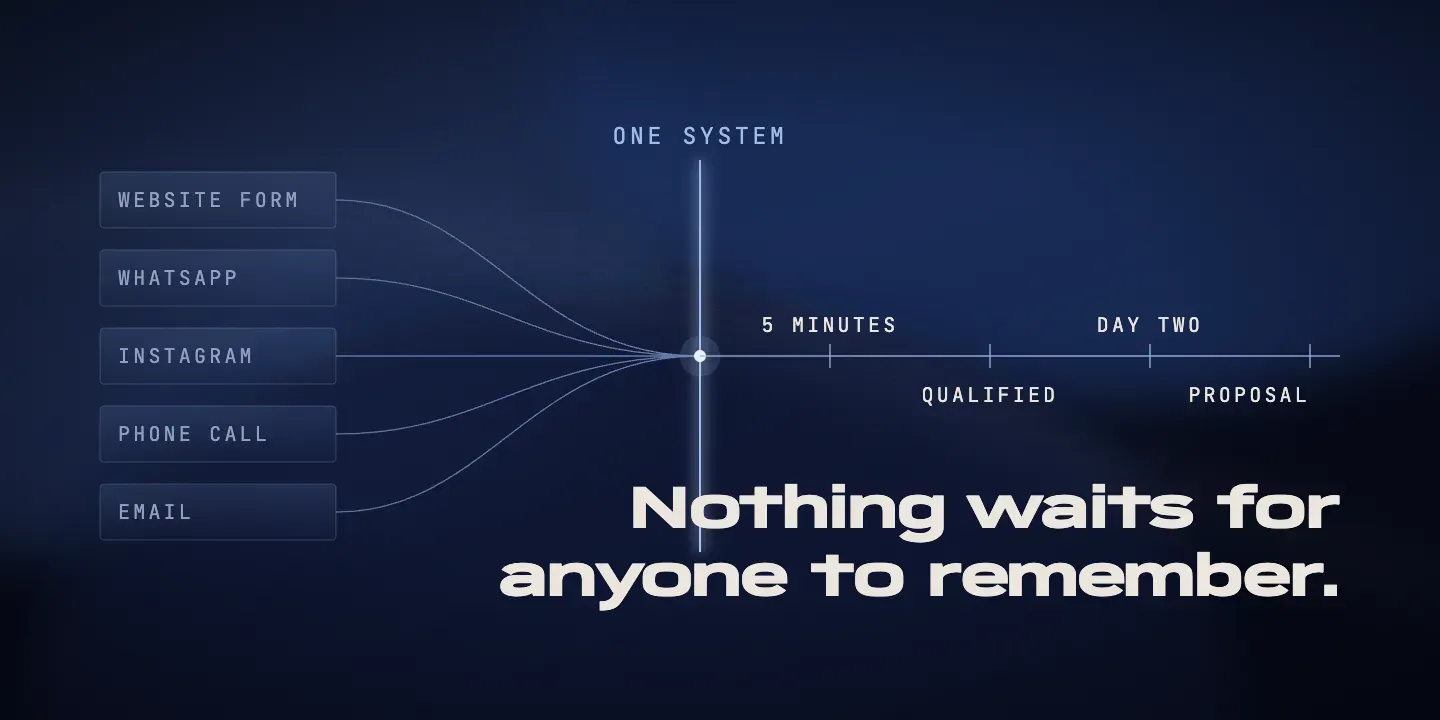
Instead of checking multiple inboxes throughout the day, businesses can automatically send every enquiry into one central CRM where each lead follows the same structured journey.
No messages disappear.
No conversations get forgotten.
No opportunities depend on someone’s memory.
What a Modern Lead Management System Looks Like
Imagine someone visits your website on a Saturday evening looking for your services.
They complete your contact form.
Within seconds, several actions happen automatically.
The enquiry is added to HubSpot CRM.
A personalised confirmation email is sent thanking the customer for getting in touch.
The lead is assigned to the appropriate salesperson based on the requested service.
A notification appears in Microsoft Teams or Slack.
A follow up task is scheduled for Monday morning.
If the customer books a meeting, Calendly automatically updates the salesperson’s calendar.
Every step happens without manual intervention.
The customer receives immediate confirmation that their enquiry has been received, while your team starts Monday knowing exactly what needs attention.
Automation Platforms Connect Everything Together
One of the biggest advantages of modern automation is that different software no longer needs to operate independently.
Platforms like Make, Zapier and n8n connect hundreds of business applications without requiring complex software development.
For example, a website enquiry can automatically create a contact inside HubSpot, notify the sales manager through Slack, generate a task inside ClickUp, send a confirmation email through Microsoft Outlook and store customer information inside Google Sheets for reporting.
Without automation, an employee would perform each of these tasks manually.
With automation, the entire workflow takes only a few seconds.
AI Is Making Lead Qualification Smarter
Not every enquiry requires the same level of attention.
Some customers are ready to buy immediately. Others are simply researching options. Some are outside your service area or have budgets that don’t match your offering.
Artificial intelligence can identify these differences before your sales team becomes involved.
Platforms built with OpenAI, Claude, Google Gemini or AI chatbot solutions can ask qualifying questions, understand customer responses and collect essential information before assigning the enquiry to the appropriate salesperson.
Instead of beginning every conversation with the same basic questions, your team already understands the customer’s needs, timeline and objectives.
Conversations become shorter, more productive and significantly more valuable.
Following Up Should Never Depend on Memory
Most sales aren’t lost because customers say no.
They’re lost because businesses stop communicating.
A quotation is sent.
The customer gets busy.
Your salesperson gets busy.
Nobody follows up.
Two weeks later, the customer has already signed with another company.
Automation removes this risk completely.
Modern CRM platforms can automatically schedule reminders, send personalised follow up emails, notify managers when opportunities become inactive and even identify which quotations haven’t been opened.
Every lead receives consistent attention without requiring constant manual supervision.
Consistency often closes more sales than persistence.
Reporting Should Be Automatic
One of the biggest frustrations for business owners is not knowing what’s happening inside the sales pipeline.
How many enquiries arrived this month?
Which marketing campaign generated them?
How quickly did the team respond?
Which salesperson converted the most customers?
Where are leads dropping out?
Without proper reporting, answering these questions often requires hours of manual work.
Modern CRM platforms like HubSpot, Pipedrive, Salesforce and Zoho CRM, combined with reporting tools such as Power BI, Looker Studio or Tableau, generate this information automatically.
Instead of collecting data, business owners spend their time improving it.
That’s where real growth begins.
Lead Management Is About Customer Experience
Customers rarely notice great lead management.
They simply experience a business that replies quickly, remembers previous conversations and communicates professionally throughout the sales journey.
Behind that experience is a carefully designed system.
Every confirmation email.
Every reminder.
Every follow up.
Every calendar invitation.
Every CRM update.
These small interactions build trust long before a customer signs a contract.
Businesses often focus on improving advertisements while overlooking the experience that follows the click. In reality, both stages deserve equal attention.
How DIGI MANTA Builds Automated Lead Management Systems
At DIGI MANTA, we don’t simply install CRM software and hand over login details.
We begin by understanding how enquiries move through your business today. We identify delays, repetitive tasks, communication gaps and opportunities where customers are being lost. Only then do we design an automated lead management system that fits the way your business actually operates.
Whether that’s implementing HubSpot, Pipedrive or Zoho CRM, connecting systems through Make or n8n, building AI powered qualification assistants with OpenAI or Claude, or creating real time dashboards for management, every recommendation is made with one objective in mind.
Helping your business convert more enquiries into customers.
Generating leads will always be important.
Managing those leads properly is what turns marketing into measurable business growth.
At DIGI MANTA, we combine Business Development, Sales Strategy, CRM Implementation and AI Automation to help businesses build lead management systems that never rely on memory, minimise missed opportunities and create a sales process ready to grow with the business.