AutomationJuly 2026
Claude AI for Business: Why It's Becoming the First Choice for Strategy, Research and Long Form Content
Choosing an AI model is almost as hard as implementing one. Here is where Claude performs best for strategy, research and long-form content.
Artificial intelligence has changed the way businesses work, but choosing the right AI model has become almost as challenging as implementing AI itself. Every few months another platform promises better reasoning, faster responses or more advanced features. ChatGPT, Claude, Gemini, Copilot, Grok and Perplexity all compete for attention, leaving many business owners wondering which one actually delivers the most value.
The truth is that there isn’t one AI model that does everything perfectly. Each platform has strengths, and the best businesses choose the right tool for the right task rather than expecting one solution to solve every problem.
Claude has quickly become one of the most respected AI assistants among consultants, developers, marketers and business leaders. While it may not receive as much mainstream attention as ChatGPT, it has earned a reputation for something businesses value above everything else: producing thoughtful, well structured work that requires less editing.
What Is Claude?
Claude is an artificial intelligence assistant developed by Anthropic, an AI company founded by former OpenAI researchers. The platform was built with a strong focus on reasoning, safety and natural conversation. Rather than simply generating text, Claude is designed to analyse information, understand context and produce responses that feel logical and coherent.
For businesses, this matters because AI is no longer being used only to answer simple questions. Companies are asking AI to review contracts, analyse financial reports, develop business strategies, write proposals, improve documentation and assist with technical work. These tasks require much more than fast text generation. They require careful thinking.
This is where Claude has gained a strong reputation.
Where Claude Performs Exceptionally Well
One of Claude’s biggest strengths is working with large amounts of information. Businesses regularly deal with lengthy reports, policies, proposals and research documents that can take hours to review manually.
Claude can analyse these documents, identify key themes, summarise findings and answer specific questions about the content. Instead of searching through dozens of pages, users can ask direct questions and receive organised, contextual answers.
This makes Claude particularly valuable for consultants, legal professionals, project managers, researchers and executives who regularly work with extensive documentation.
Rather than replacing expertise, Claude helps professionals process information faster and make better informed decisions.
Claude Produces More Natural Writing
Writing quality remains one of the biggest differences between AI platforms.
Many AI models produce content that sounds repetitive or overly enthusiastic. Businesses quickly recognise phrases that feel generic because similar wording appears across thousands of websites.
Claude generally produces writing that feels calmer, more structured and more human. Its responses often require fewer edits, particularly when writing reports, business proposals, policies or long form articles.
This doesn’t mean Claude replaces professional copywriters. Strong messaging still requires human understanding, brand positioning and strategic thinking. However, Claude can significantly reduce the time required to prepare first drafts and organise complex ideas.
For businesses creating large amounts of written content, this represents a considerable productivity gain.
Claude Isn’t Just for Writers
Many people assume AI is primarily useful for creating marketing content. In reality, Claude supports almost every department within a business.
Human Resources teams can use it to prepare job descriptions, employee handbooks and internal policies.
Operations managers can document workflows and create standard operating procedures.
Finance teams can summarise reports and explain complex financial information in plain language.
Business consultants can organise workshops, develop presentations and prepare strategic recommendations.
Developers can review code, explain technical concepts and identify potential improvements before deployment.
The value comes from reducing repetitive thinking, allowing professionals to focus on decisions that require experience and judgement.
Claude vs ChatGPT
One of the most common questions businesses ask is whether they should choose Claude or ChatGPT.
The answer depends entirely on how the platform will be used.
Claude is widely recognised for producing structured writing, analysing large documents and maintaining context during lengthy conversations. It performs particularly well when users need detailed explanations, long reports or strategic thinking.
ChatGPT offers a broader ecosystem. Businesses can build custom GPTs, generate images, browse the web, integrate external tools and automate workflows. It is often the better choice for companies looking for an all in one AI workspace.
For many organisations, this isn’t a competition.
They use both.
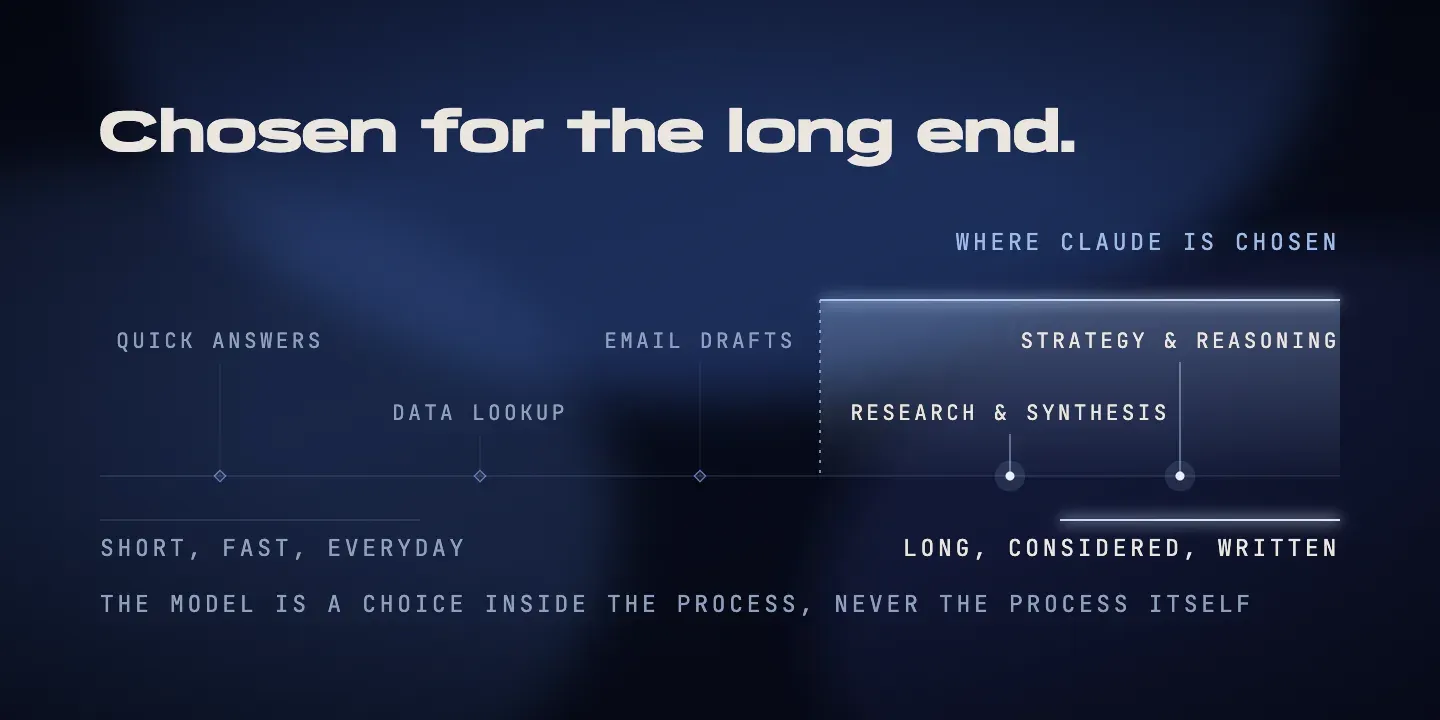
Claude handles strategy, research and long form writing, while ChatGPT supports automation, brainstorming, coding assistance and daily productivity.
Choosing between them should be based on business needs rather than brand popularity.
Claude Works Best When Combined With Other Tools
Artificial intelligence rarely delivers its full value in isolation.
Many businesses combine Claude with platforms such as Notion, Google Workspace, Microsoft 365, HubSpot, Slack and automation platforms like Make or Zapier.
For example, meeting notes generated in Microsoft Teams can be automatically organised before being reviewed in Claude. Customer feedback collected through HubSpot can be analysed to identify recurring issues. Internal documentation stored in Notion can be reviewed and improved without manually editing every page.
The goal is not to introduce another application into the business. The goal is to reduce repetitive work while improving decision making.
The Biggest Mistake Businesses Make With AI
Many organisations believe AI automatically produces high quality work.
It doesn’t.
Artificial intelligence depends entirely on the information and instructions it receives. Poor prompts produce poor results. Incomplete business knowledge leads to incomplete recommendations.
This is why businesses should never copy AI generated content directly into proposals, websites or marketing campaigns without reviewing it. AI accelerates work, but responsibility still belongs to the people using it.
The businesses achieving the greatest success with AI treat it as a highly capable assistant rather than an autonomous decision maker.
That balance leads to better quality, fewer mistakes and greater confidence in the final outcome.
Should Every Business Use Claude?
Not necessarily.
Some businesses may find ChatGPT more suitable because of its wider range of integrations. Others may already be deeply invested in Microsoft’s ecosystem and benefit more from Copilot. Organisations relying heavily on Google Workspace may naturally choose Gemini.
The important decision isn’t selecting the most popular AI model.
It’s understanding which platform supports your workflow most effectively.
Technology should adapt to your business, not the other way around.
How DIGI MANTA Helps Businesses Adopt AI
At DIGI MANTA, we don’t recommend AI platforms based on trends or online popularity. Every business has different objectives, different teams and different processes. Choosing the wrong tool often leads to unnecessary costs and disappointing results.
We help businesses identify where AI creates genuine value, select the right platforms, integrate them into existing workflows and train teams to use them effectively. Whether that involves Claude for strategy, ChatGPT for automation, HubSpot for customer management or Make for workflow automation, every recommendation is based on measurable business outcomes rather than technology alone.
Artificial intelligence is no longer an experimental technology. It has become part of modern business. The companies that benefit most will not be those using the most AI tools, but those using the right ones for the right reasons.
At DIGI MANTA, we combine Business Development, Sales Strategy and AI Consulting to help businesses adopt artificial intelligence with purpose, ensuring technology supports growth instead of becoming another disconnected system.