StrategyJuly 2026
Business Development vs Marketing: Understanding the Difference Could Save Your Business
Marketing creates demand; business development creates opportunities. Confusing the two can cost a business its growth.
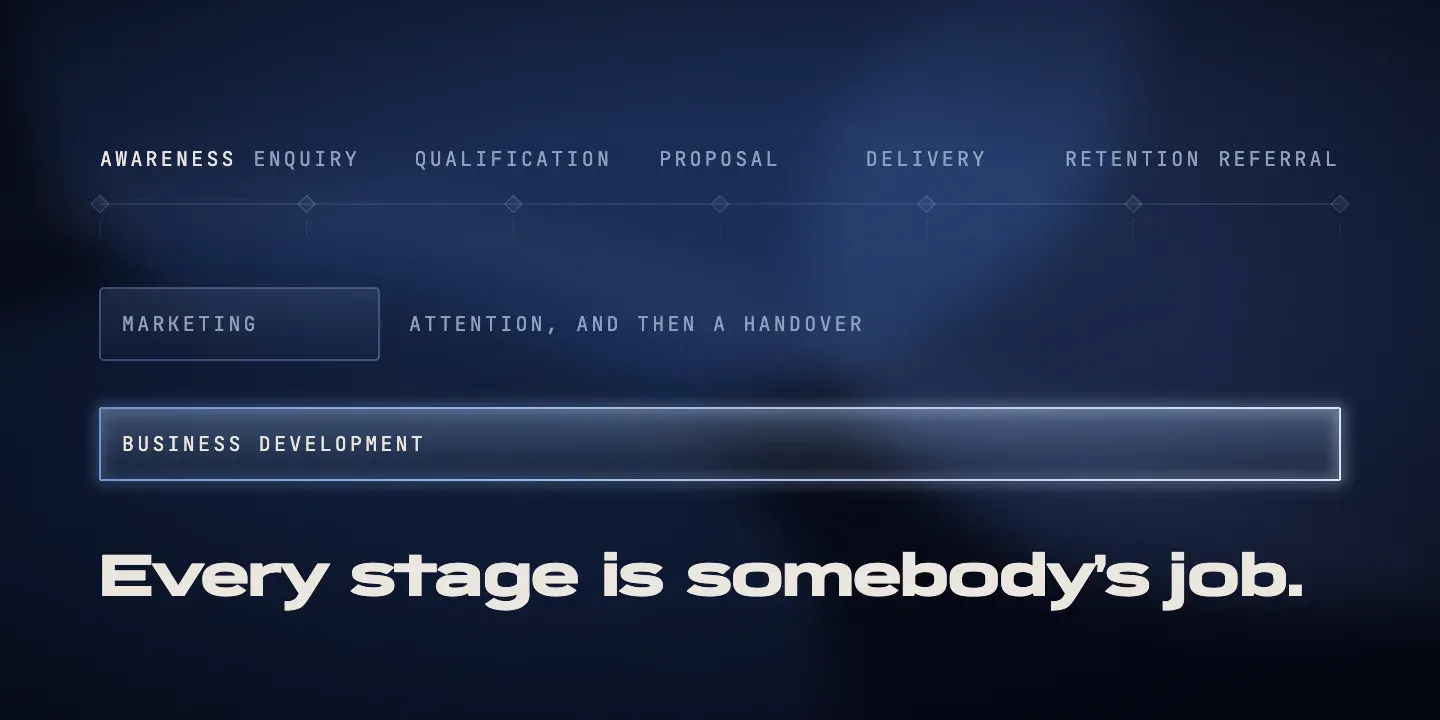
For many business owners, the terms marketing and business development have become almost interchangeable. When revenue slows, the instinctive response is often to invest in advertising, redesign the website or become more active on social media. These initiatives may generate visibility, but visibility alone does not guarantee growth.
The confusion is understandable. Marketing is one of the most visible functions within a business. Successful campaigns attract attention, increase website traffic and generate enquiries. Yet many companies discover that despite investing heavily in marketing, revenue remains inconsistent, customer acquisition costs continue to rise and long-term growth becomes increasingly difficult to sustain.
The reason is simple. Marketing is only one component of a much larger growth strategy.
Business development takes a broader perspective. Rather than asking how to attract more customers, it asks how to build a stronger, more profitable and more resilient business. It examines the systems, processes and decisions that influence growth long before a marketing campaign is launched.
Understanding the distinction between these two disciplines is more than a matter of terminology. It fundamentally changes how organisations invest their resources and where they focus their attention.
Marketing Creates Demand. Business Development Creates Opportunities.
Marketing exists to influence perception and generate demand. It introduces potential customers to your brand, communicates your value proposition and encourages prospects to begin their buying journey.
Business development operates at a different level.
Instead of concentrating solely on customer acquisition, it evaluates the overall direction of the business. It considers questions such as:
- Are we targeting the right market?
- Does our pricing reflect the value we provide?
- Which services generate the highest profitability?
- Where are we losing customers during the buying journey?
- Are there partnerships that could accelerate growth?
- Can automation improve efficiency and customer experience?
These questions rarely appear in a marketing meeting, yet they often have a greater influence on long-term profitability than any advertising campaign.
Marketing helps people discover your business.
Business development determines whether your business is built to grow once they do.
Why More Marketing Doesn’t Always Produce More Revenue
One of the most common assumptions in business is that declining sales automatically require increased marketing activity.
In reality, marketing often receives responsibility for problems it cannot solve.
Imagine a company that generates one hundred qualified enquiries every month. At first glance, the logical objective appears to be generating two hundred enquiries instead. However, a closer examination reveals that only thirty percent of prospects receive a follow-up within twenty-four hours, proposals are inconsistent and customer information is scattered across spreadsheets instead of being managed through a CRM.
Doubling the number of enquiries simply doubles the number of missed opportunities.
The issue is not marketing.
The issue is execution.
Business development focuses on identifying these operational weaknesses before additional investment is made. In many cases, improving conversion rates produces a greater return than increasing advertising spend because it extracts more value from opportunities the business is already generating.
Sustainable Growth Depends on the Entire Customer Journey
Customers rarely evaluate a business based on a single interaction.
Their perception develops through a sequence of experiences that begins long before a purchase and continues long afterwards.
They discover your website.
They evaluate your credibility.
They compare competitors.
They submit an enquiry.
They wait for a response.
They receive a proposal.
They become a customer.
They experience your service.
They decide whether to recommend you to others.
Every stage influences the next.
Marketing may be responsible for introducing the business, but customer experience, operational efficiency, sales capability and post-sale support determine whether that initial interest becomes long-term revenue.
Business development examines this complete journey, identifying friction points that reduce profitability and opportunities that strengthen customer relationships.
This broader perspective explains why organisations focused on business development often outperform competitors that invest exclusively in customer acquisition.
Business Development Extends Far Beyond Sales
One of the most persistent misconceptions is that business development is simply another name for sales.
Sales focuses on converting opportunities.
Business development focuses on creating better opportunities in the first place.
It may involve identifying new markets, forming strategic partnerships, refining pricing models, expanding service offerings, improving operational efficiency or introducing technologies that reduce costs while improving customer experience.
Consider two businesses operating within the same industry.
The first continues selling the same services to the same audience through increasingly expensive advertising campaigns.
The second analyses market trends, identifies an underserved customer segment, develops a new service offering, automates administrative processes and establishes referral partnerships with complementary businesses.
Both companies continue marketing.
Only one has fundamentally improved its competitive position.
This is business development in practice.
Strategy Should Precede Marketing
Marketing performs best when it amplifies a clear business strategy.
Without that strategic foundation, even well-executed campaigns struggle to produce consistent results.
Before investing in advertising, organisations should have clear answers to several fundamental questions.
Who is our ideal customer?
Why should they choose us instead of our competitors?
Which services create the highest long-term value?
How do customers currently experience our business?
Where are opportunities being lost?
What does sustainable growth actually look like over the next three to five years?
These questions shape every future marketing decision.
Without them, campaigns often become reactive rather than strategic, driven by short-term objectives instead of long-term business outcomes.
Technology Has Changed Business Development
The role of business development has evolved significantly over the past decade.
Modern organisations have access to technologies that previous generations of business leaders could only imagine.
Customer Relationship Management platforms such as HubSpot, Salesforce, Zoho CRM and Pipedrive provide complete visibility over customer interactions.
Automation platforms including Make, Zapier and n8n remove repetitive administrative work and connect business systems that previously operated independently.
Artificial intelligence tools such as ChatGPT, Claude and Gemini assist with research, strategic planning, customer communication and internal knowledge management.
Analytics platforms transform large volumes of operational data into practical business insights.
The value of these technologies, however, lies not in the software itself but in how effectively they support business objectives.
Technology should strengthen strategy.
It should never replace it.
The Businesses Growing Fastest Think Systemically
One characteristic consistently separates high-performing organisations from average competitors.
They rarely optimise one department in isolation.
Instead, they recognise that every function influences the others.
Marketing generates qualified opportunities.
Sales converts those opportunities into revenue.
Operations delivers the customer experience.
Finance measures profitability.
Customer service builds loyalty.
Leadership aligns every department around shared objectives.
Weakness in any one area reduces the effectiveness of the entire system.
This is why sustainable growth requires collaboration rather than isolated improvement initiatives.
Business development provides the framework that connects these functions into a cohesive strategy.
Competitive Advantage Is Built Through Better Decisions
Business success is often attributed to innovation, marketing or exceptional leadership.
While these factors certainly contribute, competitive advantage is more commonly created through consistently better decisions.
Choosing the right markets.
Investing in the right technologies.
Hiring the right people.
Building efficient systems.
Improving customer retention.
Developing recurring revenue.
Strengthening operational resilience.
Each decision may appear relatively small in isolation.
Collectively, they determine whether a business merely survives or continues growing year after year.
Business development exists to improve the quality of those decisions.
Growth Is a Strategic Discipline, Not a Marketing Activity
Marketing will always remain essential.
Without visibility, even outstanding businesses struggle to attract customers.
However, sustainable growth requires far more than effective promotion.
It requires strategic thinking, operational excellence, efficient systems, strong leadership and a continuous commitment to improvement.
Businesses that recognise this distinction allocate their resources differently. Rather than viewing marketing as the solution to every challenge, they treat it as one component of an integrated growth strategy.
That shift in perspective often marks the difference between organisations that experience occasional success and those that achieve sustained, predictable growth.
How DIGI MANTA Helps Businesses Grow Beyond Marketing
At DIGI MANTA, we believe that businesses rarely suffer from a marketing problem alone.
More often, they face challenges related to positioning, sales processes, operational efficiency, customer experience or strategic direction. Marketing may increase visibility, but without strong foundations it cannot deliver sustainable growth.
Our approach begins by understanding the business as a whole. We analyse how customers discover your company, how enquiries are managed, where opportunities are being lost and which improvements will have the greatest commercial impact. Only then do we recommend marketing initiatives that support those objectives.
This is why our work extends beyond websites, advertising campaigns or branding projects. We combine Business Development, Growth Strategy, Sales Strategy, AI Consulting, CRM Implementation, Workflow Automation and Marketing into one integrated service designed to help businesses grow intelligently rather than simply become more visible.
Because lasting growth is rarely achieved by attracting more attention.
It is achieved by building a better business.