AutomationJuly 2026
AI Won't Replace Your Team. It Will Change the Way They Work.
Will AI replace jobs? The better question is how it will change the way your team works, and where people become more valuable.
Ever since artificial intelligence became mainstream, one question has dominated business conversations.
Will AI replace jobs?
It’s a fair question, but it’s also the wrong one.
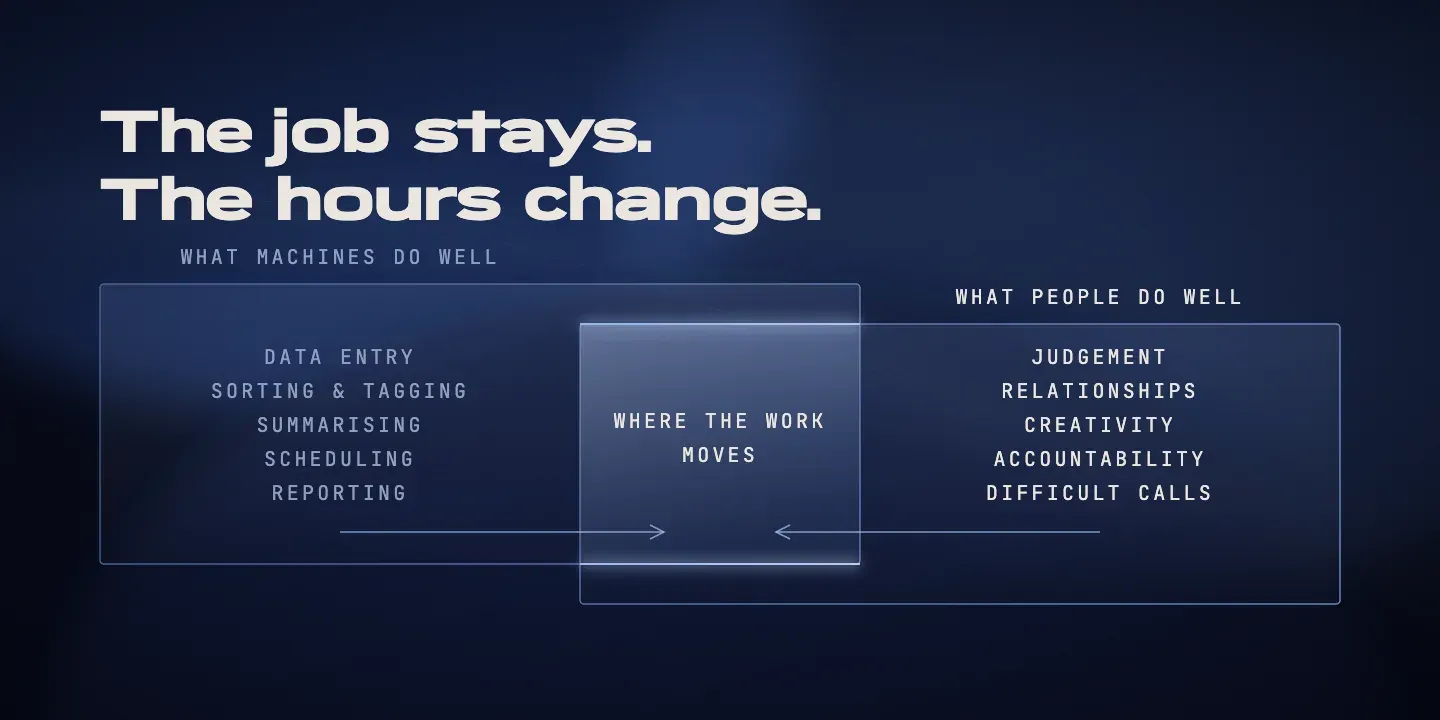
The companies gaining the biggest advantage from AI aren’t replacing entire departments. They’re removing repetitive work that slows those departments down. The result isn’t fewer people. It’s people spending more time on work that actually creates value.
History has seen this before. Computers didn’t eliminate accountants. Email didn’t replace salespeople. Online banking didn’t eliminate financial advisors. Technology changed how people worked, allowing them to become more productive rather than making them unnecessary.
Artificial intelligence is following the same pattern.
The businesses that understand this early will build stronger teams. Those that ignore it risk falling behind competitors who can deliver better service, respond faster and operate more efficiently.
AI Is Excellent at Repetitive Tasks
Every business has work that nobody particularly enjoys.
Updating spreadsheets.
Searching through emails.
Writing meeting summaries.
Scheduling appointments.
Organising files.
Entering customer information into a CRM.
Preparing reports.
None of these activities require creativity or strategic thinking, yet they consume a significant portion of the working day.
Artificial intelligence performs these tasks exceptionally well. It can summarise meetings in seconds, organise documents, draft emails, categorise customer enquiries and prepare reports that previously required hours of manual work.
That doesn’t eliminate jobs.
It eliminates unnecessary administration.
Human Skills Are Becoming More Valuable
As AI becomes better at repetitive work, the skills that cannot easily be automated become even more important.
Critical thinking.
Decision making.
Leadership.
Negotiation.
Creativity.
Building relationships.
Understanding customers.
These are the abilities that separate successful businesses from average ones, and they’re precisely the areas where people continue to outperform technology.
A customer making a significant investment doesn’t simply want information. They want confidence. They want advice based on experience. They want someone who understands their objectives and can recommend the best solution.
Artificial intelligence can support those conversations.
It cannot replace them.
Every Department Can Benefit From AI
Artificial intelligence is no longer limited to marketing or software development. Almost every department inside a business can improve productivity through automation.
Sales teams use AI to qualify leads, draft follow up emails and prepare proposals.
Marketing teams generate content ideas, analyse campaign performance and identify trends.
Human Resources departments write job descriptions, organise policies and screen applications.
Finance teams summarise reports, identify unusual spending patterns and prepare forecasts.
Customer support teams answer common questions instantly while forwarding more complex enquiries to employees.
Operations teams automate documentation, reporting and workflow management.
The objective is always the same.
Reduce repetitive work so employees can focus on higher value activities.
Businesses Should Stop Asking Whether They Need AI
Many companies are still debating whether artificial intelligence is worth adopting.
In reality, the question has already changed.
The real question is whether your competitors are already using it.
If they respond to enquiries faster, prepare quotations more quickly, analyse customer data more effectively and automate administrative work, they gain an advantage that compounds over time.
They don’t necessarily have better employees.
They simply give those employees better tools.
Businesses that delay AI adoption aren’t standing still.
They’re gradually falling behind organisations that continue improving every month.
AI Doesn’t Make Better Decisions on Its Own
One of the biggest misconceptions surrounding AI is that it always produces the right answer.
It doesn’t.
Artificial intelligence generates recommendations based on available information. If the information is incomplete, inaccurate or poorly structured, the output will reflect those weaknesses.
This is why experienced professionals remain essential.
An architect still reviews AI generated concepts.
A lawyer still reviews legal documents.
A financial advisor still validates investment recommendations.
A marketing strategist still decides which campaigns align with the company’s objectives.
Artificial intelligence accelerates decision making.
It should never replace responsibility.
Choosing the Right AI Matters
There are now dozens of AI platforms available, each designed for different purposes.
ChatGPT has become one of the most versatile business assistants, supporting writing, coding, brainstorming, automation and research.
Claude is particularly strong when analysing long documents, preparing detailed reports and supporting strategic work.
Google Gemini integrates naturally with Google Workspace, making it valuable for businesses already using Gmail, Google Docs and Google Drive.
Microsoft Copilot works closely with Microsoft 365, helping teams automate tasks inside Outlook, Excel, Word and Teams.
Specialised platforms such as Perplexity AI provide research capabilities, while tools like Midjourney, Adobe Firefly and Runway support creative production.
The best businesses don’t search for the “best AI.”
They choose the right AI for each business process.
AI Should Be Part of Your Business Strategy
Artificial intelligence should never be treated as another software subscription.
Before introducing new tools, businesses should understand exactly what they want to improve.
Do you want faster customer support?
More efficient lead management?
Better reporting?
Improved proposal writing?
Reduced administrative work?
Once the objective is clear, selecting the appropriate technology becomes significantly easier.
Without a strategy, businesses often subscribe to multiple AI platforms that overlap, create confusion and generate unnecessary costs.
Technology should support the business strategy.
It should never become the strategy.
Companies That Invest in AI Also Invest in Their People
Some business owners worry that introducing AI will create resistance among employees.
In practice, the opposite often happens.
People appreciate spending less time on repetitive administration and more time doing meaningful work.
The businesses seeing the strongest results don’t simply purchase AI software.
They train their teams.
They encourage experimentation.
They develop internal guidelines.
They create workflows that combine human expertise with artificial intelligence.
Technology alone doesn’t create competitive advantage.
The way people use technology does.
The Future Belongs to Businesses That Adapt
Artificial intelligence isn’t replacing business.
It’s changing business.
The companies that succeed over the next decade won’t necessarily have the largest budgets or the biggest teams.
They’ll be the organisations that adapt faster, remove inefficiencies and allow their people to focus on work that genuinely creates value.
AI will continue evolving.
Customer expectations will continue changing.
Businesses that embrace continuous improvement will be far better prepared than those waiting for the “perfect moment” to begin.
That moment has already passed.
How DIGI MANTA Helps Businesses Adopt AI With Confidence
At DIGI MANTA, we don’t see artificial intelligence as a replacement for people.
We see it as a tool that allows people to perform at a higher level.
Our role isn’t simply recommending software. We analyse your existing workflows, identify repetitive tasks, evaluate where automation creates measurable value and implement AI solutions that fit your business, your team and your long term objectives.
Whether that’s introducing ChatGPT, Claude, Microsoft Copilot, Gemini, AI powered customer support, CRM automation or internal knowledge assistants, every solution is selected because it solves a genuine business problem.
Artificial intelligence isn’t about replacing your employees.
It’s about giving them more time to do the work that only people can do.
At DIGI MANTA, we combine Business Development, AI Consulting, Sales Strategy and Workflow Automation to help businesses build smarter teams, improve productivity and stay competitive in a rapidly changing world.