AutomationJuly 2026
AI Sales Automation: Why Your Sales Team Shouldn't Be Doing Repetitive Work
Most businesses start by asking which AI tool to buy. The better question is which repetitive work keeps your sales team from selling.
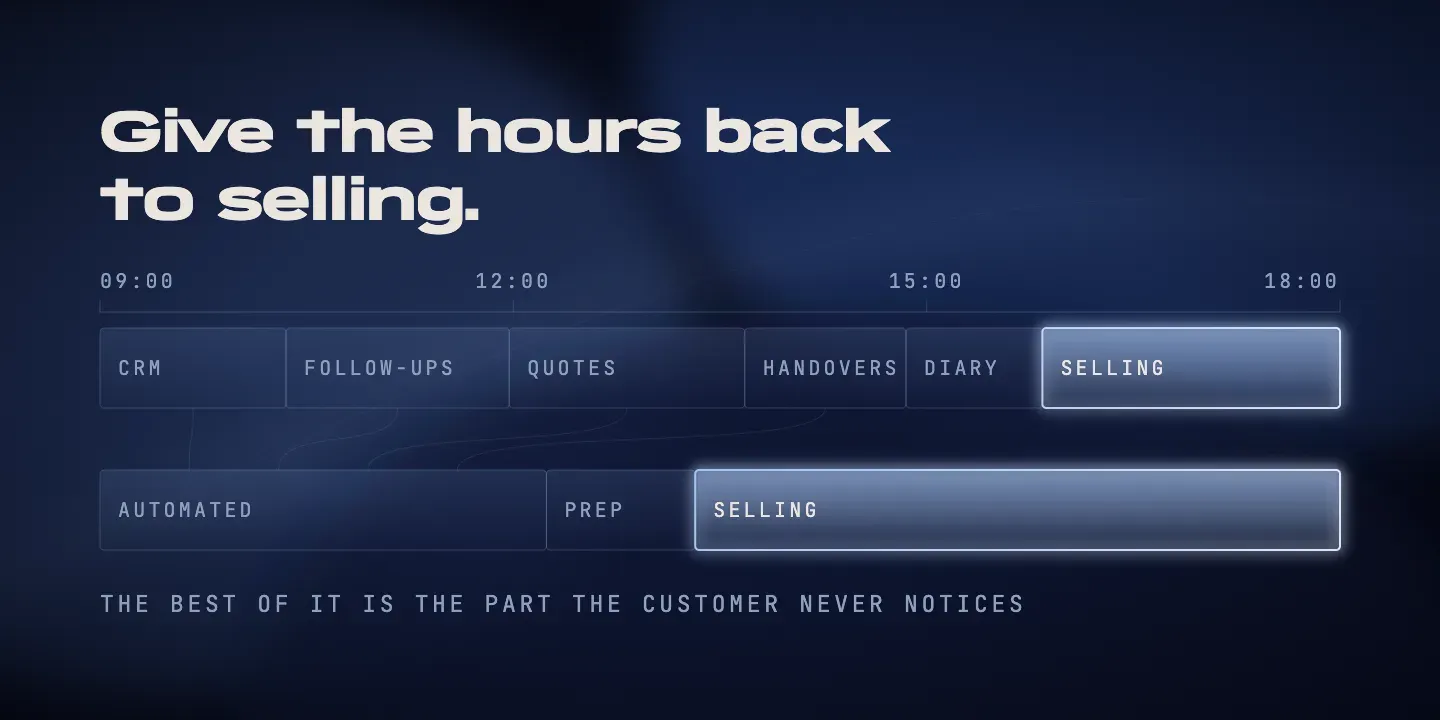
Artificial intelligence has become impossible to ignore. Every week another platform promises to automate your business, replace employees or double your productivity. The market is flooded with AI tools, each claiming to be the one that will transform the way you work.
Most businesses approach AI from the wrong direction. They start by asking which tool they should buy.
That’s the wrong question.
The better question is: which part of your sales process is slowing your business down?
Artificial intelligence is not a business strategy. It is a tool. Like any tool, its value depends entirely on how you use it. Purchasing ChatGPT, HubSpot or another automation platform won’t increase sales overnight. If your sales process is disorganised, poor decisions will simply happen faster.
The companies seeing the biggest return from AI aren’t replacing their sales teams. They’re removing the repetitive work that prevents those teams from selling.
Sales Professionals Spend Too Much Time Doing Everything Except Selling
Ask a salesperson how much of their day is spent speaking with customers and the answer is often surprising.
A significant portion of the working day disappears into administrative tasks. Updating customer records. Scheduling meetings. Sending follow up emails. Preparing proposals. Searching for previous conversations. Copying information between systems. Chasing colleagues for updates.
Every one of these tasks is necessary, but none of them directly generates revenue.
This is where artificial intelligence creates immediate value. Instead of replacing employees, it removes repetitive processes that consume valuable time. Sales teams spend less time managing information and more time building relationships with potential customers.
The result isn’t fewer people. It’s more productive people.
AI Doesn’t Sell for You. It Helps You Sell Better.
One of the biggest misconceptions surrounding artificial intelligence is that it can replace an experienced salesperson.
It can’t.
Customers still want to speak with people before making important decisions. They want reassurance, expertise and confidence that they’re choosing the right supplier. AI cannot replace trust.
What it can replace is repetition.
Imagine someone submits an enquiry through your website at 10:30 in the evening. Instead of waiting until the next morning, an AI assistant immediately starts the conversation. It asks relevant questions about the customer’s project, budget, location and timeline. It stores that information inside your CRM, categorises the enquiry, sends a confirmation email and notifies the appropriate salesperson.
By the time your office opens, your team already knows who the customer is, what they need and how urgent the enquiry is.
The customer feels heard.
Your team starts the conversation fully prepared.
The Best AI Automations Are the Ones Customers Never Notice
Many businesses think AI needs to be visible. In reality, some of the most valuable automations happen entirely behind the scenes.
A visitor completes a contact form.
Within seconds, several processes happen automatically.
The lead is added to your CRM.
A task is assigned to the correct salesperson.
A personalised confirmation email is sent.
The enquiry is tagged according to the requested service.
A follow up reminder is scheduled.
If the customer books a meeting, the appointment appears in the salesperson’s calendar automatically.
No copying and pasting.
No forgotten enquiries.
No spreadsheets.
No manual data entry.
The customer simply experiences a business that responds quickly and appears exceptionally organised.
The Right Tools Depend on the Right Strategy
There is no shortage of AI platforms available today. The challenge isn’t finding software. It’s choosing software that solves a real business problem.
For businesses looking to improve customer conversations, OpenAI ChatGPT, Claude and Google Gemini can power intelligent assistants capable of answering questions, qualifying leads and generating personalised responses.
For managing customer relationships, platforms such as HubSpot CRM, Pipedrive, Salesforce and Zoho CRM provide structured pipelines that track every stage of the sales process.
To connect different applications together, automation platforms like Make, Zapier and n8n eliminate repetitive manual work by allowing systems to exchange information automatically. A new website enquiry can instantly create a CRM contact, notify the sales team, schedule follow up tasks and trigger email sequences without any human intervention.
For appointment scheduling, solutions like Calendly, Cal.com and Microsoft Bookings remove the endless exchange of emails by allowing customers to reserve available time slots directly from your calendar.
Businesses receiving a high volume of phone enquiries are increasingly introducing AI voice agents built with platforms such as ElevenLabs Conversational AI, Retell AI, Vapi and Synthflow AI. These systems can answer calls, qualify potential customers, schedule appointments and transfer more complex conversations to a member of the sales team.
Each of these tools performs a different role. None of them replaces strategy.
Automation Without Structure Creates Chaos
This is where many businesses make expensive mistakes.
They subscribe to five different AI platforms because everyone else is talking about them. A chatbot is installed on the website. A CRM is purchased. Email automation is configured. An AI assistant writes follow up emails.
Six months later, nothing has changed.
The problem wasn’t the software.
The problem was that the business never defined its sales process in the first place.
Technology amplifies whatever already exists. If your customer journey is clear, automation makes it faster. If your customer journey is confusing, automation simply creates confusion at a much larger scale.
Before implementing AI, businesses should first understand how customers move from their first interaction to becoming loyal clients. Only then does automation become truly valuable.
Data Is One of AI’s Biggest Advantages
Another reason businesses invest in AI is visibility.
Without reliable data, improving sales becomes almost impossible. Business owners often know how much revenue they generated, but they don’t know why one salesperson performs better than another or why certain marketing campaigns produce higher quality enquiries.
Modern CRM platforms combined with AI reporting tools such as HubSpot Analytics, Microsoft Power BI, Looker Studio and Tableau allow businesses to monitor every stage of their sales pipeline. They reveal where leads are dropping off, how quickly enquiries receive responses, which services generate the highest conversion rates and where improvements should be made.
Instead of making decisions based on assumptions, leaders can make decisions supported by real business data.
How DIGI MANTA Helps Businesses Implement AI
At DIGI MANTA, we don’t recommend artificial intelligence because it’s the latest trend. We recommend it when it solves a genuine business challenge.
Every company operates differently. Some businesses lose customers because they respond too slowly. Others struggle with inconsistent follow ups, poor lead management or disconnected software. Before recommending any platform, we analyse how your sales process works today and identify where automation can create the greatest impact.
Sometimes that means implementing HubSpot to centralise customer information. In other cases, it’s connecting existing systems through Make or n8n, building an AI assistant with OpenAI or Claude, introducing an AI voice agent or creating automated reporting dashboards for management.
The technology is never the objective.
Growing your business is.
At DIGI MANTA, we combine Business Development, Sales Strategy and AI Automation to help businesses build sales systems that are faster, smarter and ready to scale. That’s where automation delivers its greatest value.